Voyelles: Mapping Semantic Networks from Rimbaud to Neural Networks
This piece explores Voyelles, a poem written by Arthur Rimbaud, not merely as symbolist poetry, but as an intuitive experiment in semantic representation — a poetic anticipation of how modern AI understands meaning through distributed patterns across latent space.
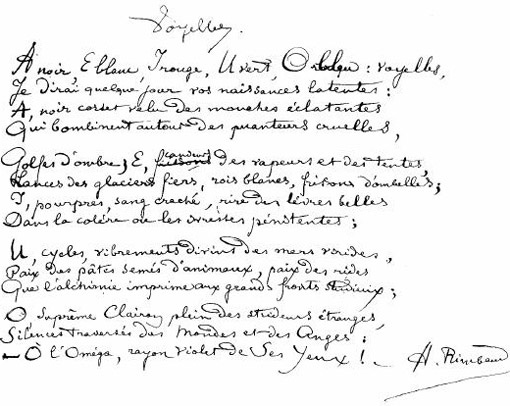
Voyelles
A noir, E blanc, I rouge, U vert, O bleu: voyelles,
Je dirai quelque jour vos naissances latentes:
A, noir corset velu des mouches éclatantes
Qui bombinent autour des puanteurs cruelles,
Golfes d'ombre; E, candeurs des vapeurs et des tentes,
Lances des glaciers fiers, rois blancs, frissons d'ombelles;
I, pourpres, sang craché, rire des lèvres belles
Dans la colère ou les ivresses pénitentes;
U, cycles, vibrements divins des mers virides,
Paix des pâtis semés d'animaux, paix des rides
Que l'alchimie imprime aux grands fronts studieux;
O, suprême Clairon plein des strideurs étranges,
Silences traversés des [Mondes et des Anges]:
—O l'Oméga, rayon violet de [Ses] Yeux!
Arthur Rimbaud (see Footnote 1 for English translation1)
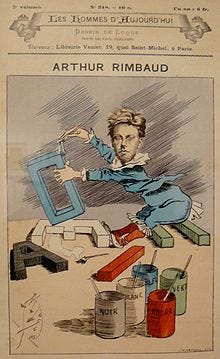
Rimbaud and Voyelles
In 1871, at just 17 years old, Arthur Rimbaud wrote "Voyelles," a sonnet that's become one of the most enigmatic and debated works in French poetry. This synaesthetic poem starts by assigning a colour to each vowel, as if revealing the cipher for a secret language, and proceeds to build intricate webs of associations around these colours. I read that it is the first Rimabaldian poem to use association as primary writing mode.
In the poem, each vowel acts as an anchor for an expanding network of images, sensations, and concepts that stretch language to its limits.
"Chaque voyelle est illustrée d'un ou plusieurs tableaux qui sont autant d'hallucinations, d'illuminations. Il y en a treize dans une sorte de kaléidoscope mettant à contribution tous les sens. Il y a fusion des évocations de couleurs, d'odeurs, de sons, de mouvements, avec une préférence des formes et des sons."
One of the intriguing aspects of "Voyelles" is its status as both a serious poetic endeavour and what Verlaine would later call "un peu fumiste" (somewhat playful or unserious) in his 1895 preface to Rimbaud's complete works. Critics have proposed countless interpretations: Ernest Gaubert saw it as reminiscent of a children's alphabet book, Jacques Gengoux interpreted it as an esoteric system, and later readings found political, social, and even erotic meanings.
These diverse interpretations feel almost silly, and speaks to Rimbaud's success in touching something fundamental about language and meaning. It is something profound enough that critics and readers, sensing its presence but unable to fully grasp it, have projected various interpretations onto the work.
A Rimbaud specialist, René Étiemble, finds that, "decidedly, we might be taking the myth of Rimbaud a bit too seriously". And it may be through trying too hard to interpret and analyse "Voyelles" that critics came to miss something more fundamental about what Rimbaud was attempting to do.
C'est le jour où le sonnet des Voyelles ne sera plus pris au sérieux qu'on l'on pourra parler sérieusement de Rimbaud.
René Étiemble, Le Mythe de Rimbaud, 1968.
In this post I defend the idea that 'Voyelles' encodes insights about the relationship between meaning, thought and language, but these remains opaque without a proper framework to study it.
Letter of the Seer, and the quest for a universal language
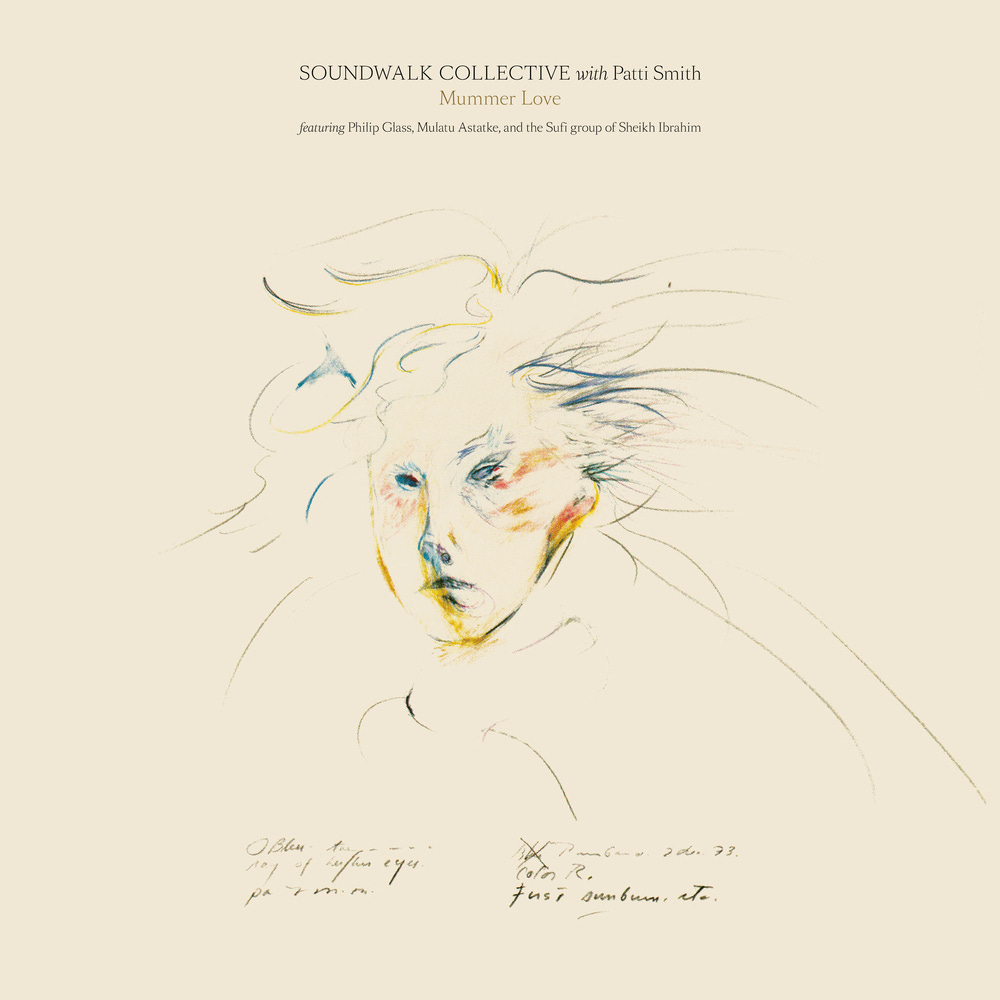
In his famous "Letter of the Seer" to Paul Demeny, written in the same year as "Voyelles," Rimbaud himself seemed to anticipate both the serious theoretical implications and potential over-interpretation of his work. He wrote of a "universal language" that would be "soul speaking to soul, encompassing everything, perfumes, sounds, colours, thought clasping thought and pulling."
Toute parole étant idée, le temps d'un langage universel viendra ! Il faut être académicien, — plus mort qu'un fossile, — pour parfaire un dictionnaire [...]. Des faibles se mettraient à penser sur la première lettre de l'alphabet, qui pourraient vite ruer dans la folie ! — Cette langue sera de l'âme pour l'âme, résumant tout, parfums, sons, couleurs, de la pensée accrochant la pensée et tirant.
Arthur Rimbaud, Lettre à Paul Demeny, 15 mai 1871.
One of the key ideas from his writing here seems to be that a word, an uttering, une parole, is an idea - not in the sense of representing an idea, but by being the idea itself. The word is the meaning in action - it's the actual process of associations unfolding, the "pensée accrochant la pensée et tirant" (thought hooking onto thought and pulling). He ridicules the dictionary, and the idea of systematically trying to pin down definitions, showcasing how limiting it is in comparison to the richness of meaning even through the very way he writes to explain it. Even a single letter, he goes, if one were to really contemplate its full web of associations and meanings, contains such vast depths that it could overwhelm the unprepared mind.
This view can be interesting to contrast with the one of his contemporary, Ferdinand de Saussure, considered as a founding figure of linguistics. In Saussure's view, words are signs composed of two parts: the signifier (sound-image), and the signified (concept).
For Saussure, these word-signs operate in a structured system where meaning emerges from their relationships and differences with other signs. A word means what it means because of how it differs from other words in the system. The connection between signifier and signified is arbitrary - there's no inherent reason why the sound "tree" should represent the concept of a tree. This systematic view of language allowed for its scientific study, that one could argue influenced the birth of modern cognitive science.
To use a metaphor: Saussure sees words as pieces in a vast mechanical system, like cogs in a machine, where meaning comes from how they fit together. Rimbaud sees words as living seeds that contain entire worlds of experience and possibility, capable of growing and transforming both themselves and those who encounter them.
In my opinion, beyond exploring language and writing poetry, Rimbaud was also offering a theory of semantic representations in the mind, or perhaps more accurately an empirical display of it through his poetry.
I'd like to try and explain how his view can perhaps be aligned with how meaning is represented and understood in today's artificial intelligence systems (also known as large language models), which offer the best theory of how meaning and language work in the mind today.
Computational Parallels
One thing that particularly caught my attention is Rimbaud's use of the phrase "naissances latentes", which really feels like a poetical pre-sentiment of the concept of "latent space" or "embedding space" (sometimes described as "plongement latent" in technical french). Latent space is the space into which embedding vectors (the number vectors that represent words or concepts) are mapped in machine learning models. Both of these latent things describe hidden, or non-directly observable, meanings/representations, "waiting to emerge". One in a highly evocative and poetic way, the other one in a technical and mathematical way.
I can't help but see a parallel between young Rimbaud exploring how meaning can be traversed "empirically" through a network of association, and how another teenager would be similarly captivated by so called "distributed representations" roughly a century later. Geoffrey Hinton, in his mid-teens in the 1960s, was introduced to the concept of holograms – where information is spread across the entire medium rather than localised in specific points. This idea that memory and meaning might be distributed throughout the brain "like a hologram" sparked Hinton's lifelong work on neural networks and distributed representations, giving rise to the rapid progress we've seen over the last decade.
The contrasting theories between Rimbaud and De Saussure are eerily reminiscent of computational debates that would occur a hundred years later. While Rimbaud explored this through poetic associations radiating from colour concepts, Hinton formalised these ideas through his work on distributed representations in neural networks. In a book chapter titled "Distributed representations", Hinton, McLelland and Rumelhart write the following:
Given a network of simple computing elements and some entities to be represented , the most straightforward scheme is to use one computing element for each entity. This is called a local representation. It is easy to understand and easy to implement because the structure of the physical network mirrors the structure of the knowledge it contains. The naturalness and simplicity of this relationship between the knowledge and the hardware that implements it have led many people to simply assume that local representations are the best way to use parallel hardware.
There are, of course, a wide variety of more complicated implementations in which there is no one-to-one correspondence between concepts and hardware units , but these implementations are only worth considering if they lead to increased efficiency or, interesting emergent properties that cannot be conveniently achieved using local representations.
This chapter describes one type of representation that is less familiar and harder to think about than local representations. Each entity is represented by a pattern of activity distributed over many computing elements , and each computing element is involved in representing many different entities. The strength of this more complicated kind of representation does not lie in its notational convenience or its ease of implementation in a conventional computer, but rather in the efficiency with which it makes use of the processing abilities of networks of simple , neuron-like computing elements.
Every representational scheme has its good and bad points. Distributed representations are no exception. Some desirable properties arise very naturally from the use of patterns of activity as representations. Other properties , like the ability to temporarily store a large set of arbitrary associations , are much harder to achieve. As we shall see , the best psychological evidence for distributed representations is the degree to which their strengths and weaknesses match those of the human mind.
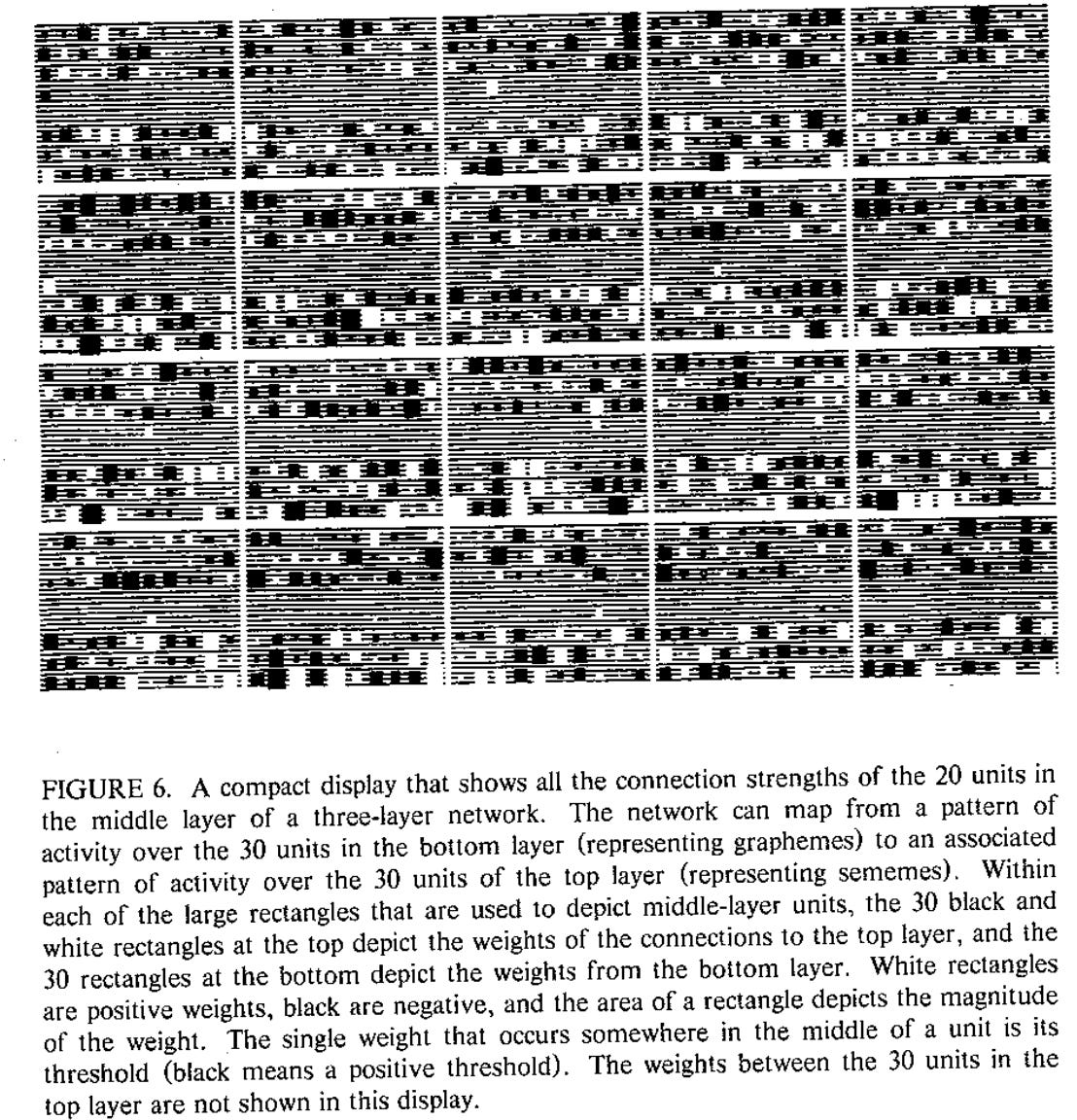
Both Hinton and Rimbaud recognised that complex meanings emerge not from isolated points but from patterns of activation across a broader space – whether that space is semantic, neural, or poetic. Rimbaud's "naissances latentes" seems to poetically prefigure these fundamental insight about how information might be encoded in the mind.
Below, I'll try and explain why I think Rimbaud's "Voyelles" deserves to be understood not just as an iconic piece of symbolist poetry, but as an early exploration of how meaning can be systematically represented and transformed.
Patterns of movement in semantic space
In his poem, Rimbaud's method can be likened to a musician exploring the full expressive range of an infinite synthesiser, with vowels and their associated colours as the fundamental notes or frequencies, while he uses different semantic dimensions - movement patterns, material and mental states, cosmic elements, natural forms - as the dials that modulate their tone and texture. Each knob twist alters the sound's character, much as Rimbaud transforms each vowel's colour through layers of meaning (this idea of a "Synthesizer for thought" is explored by the Sephist here).
What's particularly striking about "Voyelles" is that while its associations might initially appear random or purely imaginative, there's seems to be a distinct structural logic to how Rimbaud builds these semantic chains. Rather than free association, each sequence systematically pushes at the boundaries of its anchor colour-concept in specific, controlled directions. The tension created feels carefully orchestrated to stretch the semantic space around each colour to its limits while maintaining coherent connections. This creates a kind of controlled explosion of meaning that radiates outward from each colour-vowel pair.
The sequence 'noir corset velu des mouches éclatantes' ('black hirsute corset of the flashing flies') exemplifies his mastery of creating maximum semantic voltage through carefully layered contradictions and sensory expansions.
Starting with pure visual darkness, he weaves through multiple domains: the tactile constriction of the 'corset,' the bestial texture of 'velu' (hairy/furry/hirsute), the auditory vibration of buzzing flies ('bombinent'), putrid smells ('puanteurs'), culminating in the cosmic void of 'golfes d'ombre.'
This play of words and associations is a delightful demonstration of how meaning is created through the resonance between the words as they are being thought/spoken.
Mathematical movements
Let us now look at how it can be understood as a series of precise semantic operations applied to a base vector, using the more mathematical language of Hinton and the likes.
A noir
Starting with 'noir' as the fundamental concept (the colour black), each subsequent word can be seen as constructed through specific transformational operations. 'Corset' emerges from combining the base darkness with vectors of elegance, constraint, and civilisation - resulting in the black corset as a symbol of cultivated restraint. In contrast, 'velu' applies an opposite set of transformations to the same base, adding dimensions of bestial, raw, and untamed qualities to create the image of dark bristling fur.
This controlled opposition reaches its apex with 'mouches', which, coup de maitre by Rimbaud perhaps, activates two parallel semantic networks simultaneously thanks to the two distinct meanings of the word mouche. Along the refinement pathway, it connects to black beauty marks - continuing the theme of fashionable decoration. Along the natural pathway, it evokes dark flies - extending the bestial imagery. Both interpretations remain perfectly coherent with the preceding terms while maximising semantic tension (refined elegance against bestial ugliness). The final term 'éclatantes' (blasting/blazing/flashing) applies a brilliance vector that aims to contrast maximally against the base concept of black, while simultaneously enriching both interpretations of 'mouches' - whether as shining beauty marks or uncannily brilliant flies.
To summarise the latent path in "black conceptual space", Rimbaud goes :
1. [elegance + constraint + civilisation]
2. [bestial + raw + untamed]
3. [bestial + insect] AND/OR [elegance + beauty]
4. [brightness + vivid]
By latent path, I mean that we're looking at the abstract path taken by Rimbaud applied to the colour black, i.e. how he moves in meaning space independent of where in the space he is. To make this more clear, here is an example of the same movement path, as applied to red: "Rouge velours saignant des roses astrales" (Red velvet bleeding with astral roses). (NB: Rose might not carry the brilliant duality that mouches did but I'm not Rimbaud!)
E blanc
The 'E' sequence oscillates between opposing manifestations of whiteness. It moves from ethereal vapours and tents ("candeurs des vapeurs et des tentes" - candors of vapours and tents) through the sharp hardness of glaciers ("lances des glaciers fiers" - lances of proud glaciers) and the majesty of "rois blancs" (white kings), finally arriving at the botanical delicacy of "frissons d'ombelles" (trembles of umbels).
The progression through white conceptual space could be summarised as:
1. [ethereal + formless + temporary]
2. [sharp + solid + proud]
3. [regal + powerful + authoritative]
4. [delicate + natural + vibrating]
Like in the black sequence, each transformation maintains connection to the base white vector while exploring contrasting qualities - from ethereal vapour to solid ice, from majestic authority to trembling delicacy. However, where the black sequence created tension through cultural/bestial opposition, the white sequence creates its semantic voltage through transitions between states of matter (gas/vapour → solid ice) and scales of power (delicate flowers → majestic kings).
I rouge
When exploring 'I' (rouge), Rimbaud pushes again each manifestation of redness to its limit: from the visceral physical expression ("sang craché" - spat blood) through sensual beauty ("lèvres belles" - beautiful lips), to the peak of raw emotion ("colère" - anger), finally reaching spiritual experience ("ivresses pénitentes" - penitent drunkenness). Each step maximises tension with its neighbours while maintaining connection to the central colour concept.
Summary of rouge latent path:
1. [physical + violent + expulsive]
2. [beautiful + sensual + attractive]
3. [emotional + intense + passionate]
4. [spiritual + penitent + ecstatic]
U vert
The 'U' (vert) sequence traces a remarkable transformation from nature to intellect. Beginning with green seas and peaceful pastures, it progresses to "paix des rides / Que l'alchimie imprime aux grands fronts studieux" - the peace of wrinkles/the furrows that alchemy imprints on large studious foreheads. The progression preserves its connection to green while ascending from natural peace to contemplative and intellectual peace.
Summary of vert latent path:
1. [cosmic + rhythmic + divine]
2. [peaceful + pastoral + natural]
3. [intellectual + alchemical + contemplative]
O bleu
The 'O' sequence creates vertical ascension themed around celestial ideas (blue). From an earthly trumpet blast ("suprême Clairon"), it rises through strange resonances to cosmic silence, reaching divine realms. This upward movement transforms both medium (sound to silence) and colour (blue to violet), suggesting transcendence of physical limitations.
Summary of bleu latent path:
1. [earthly + sonic + majestic]
2. [strange + resonant + ascending]
3. [cosmic + silent + angelic]
4. [transformed + transcendent + divine]
Overview of colourful movements
These movement patterns reveal Rimbaud's systematic exploration of how meaning can be structured and transformed in the mind. Each word adds a new semantic layer to the image he's painting.
Each sequence also shows a distinct pattern of "semantic transformation", or a way of moving through the space of meaning, while maintaining connection to its base colour vector:
Noir created tension through cultural/bestial opposition and blanc through states of matter.
- Rouge moves from physical → emotional → spiritual
- Vert ascends from natural → intellectual realms
- Bleu creates vertical movement from earthly → cosmic domains
These sequences create their semantic voltage through progressive transformations along specific conceptual axes (physical→spiritual, natural→intellectual, earthly→divine).
In this way, though this rich diversity of movement patterns, the poem almost feels like a masterclass or a demonstration in how to move through semantic space.
Language enchantment
While our technical understanding of language through LLMs might align with Rimbaud's intuitions about meaning, there's a darker irony at play. The very systems that validate his view of language as vast networks of living associations are increasingly being used to flatten and commodify language itself; "des squelettes qui ont accumulé les produits de leur intelligence borgnesse" (skeletons who have accumulated the products of their myopic, blinkered intelligence)
When Rimbaud mocked academics making dictionaries, the "académiciens, plus morts qu'un fossile" (One has to be an academician – deader than a fossil – to finish a dictionary of any language at all), he was criticising the reduction of language to systematic, lifeless forms. Today, we face a perhaps more insidious form of linguistic death.
As language becomes increasingly mechanised and commodified, we might need to consciously preserve spaces for the kind of deep, transformative engagement with language that Rimbaud championed. In this sense, "Voyelles" is also a reminder of language's power to enchant, transform, and reveal - powers that persist even in our age of artificial generation, but only if we remain capable of experiencing them.
"Cette langue sera de l'âme pour l'âme"
Arthur Rimbaud
References
Rimbaud and Poem Analysis:
-
http://rimbaudexplique.free.fr/poemes/voyelles.html
-
https://www.mediaclasse.fr/lectures/197
-
https://fr.wikisource.org/wiki/Lettre_de_Rimbaud_%C3%A0_Paul_Demeny_-_15_mai_1871
-
https://www.worldofinteriors.com/story/patti-smith-arthur-rimbaud
Representing thought
-
https://stephango.com/photoshop-for-text
-
https://thesephist.com/posts/synth/
-
https://wattenberger.com/thoughts/yay-embeddings-math
-
https://interconnected.org/home/2024/05/31/camera
-
https://x.com/ocuatrecasas/status/1667717542784147456
Notes on embeddings
-
https://vickiboykis.com/what_are_embeddings/
-
https://cohere.com/llmu/text-embeddings
Interpreting large language models
-
https://www.anthropic.com/research/mapping-mind-language-model
Hinton, distributed representations and holograms
-
https://www.corememory.com/p/oralhistorywithgeoffhinton
-
https://stanford.edu/~jlmcc/papers/PDP/Chapter3.pdf
Vowels
A black, E white, I red, U green, O blue: vowels,
I will tell someday your latent births:
A, black hirsute corset of the flashing flies
That buzz around the cruel stenches,
Gulfs of shadow; E, candors of vapors and tents,
Lances of proud glaciers, white kings, trembles of umbels;
I, crimsons, spat blood, laughter from beautiful lips
In anger or penitent drunkenness;
U, cycles, divine vibrations of viridian seas,
Peace of pastures scattered with animals, peace of the furrows
That alchemy imprints on great studious foreheads;
O, supreme Clarion full of strange stridencies,
Silences crossed by [Worlds and Angels]:
—O the Omega, violet ray of [Her] Eyes!
my translation - focused on semantic precision